

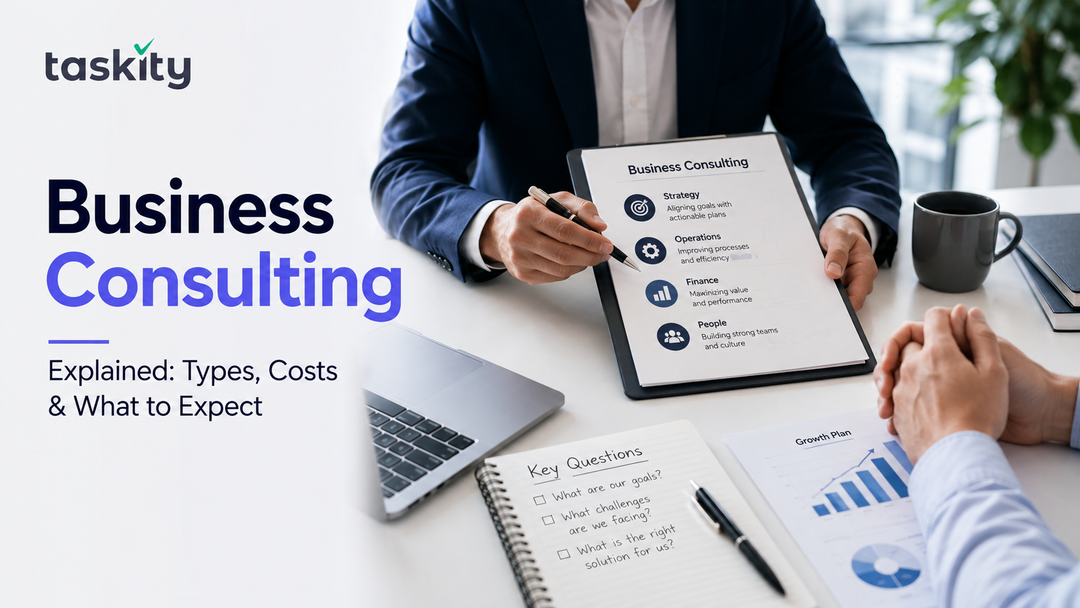
The entrepreneur brings on board a consultant because he thinks this particular issue will be solved within a week. But the first week turns out to be a bunch of questions. What is your sales process like? What has to be approved? Where does your real bottleneck stand? There is no advice yet, just a stranger going through things you have been leaving unexplored all this time.
This usually confuses many entrepreneurs for the first time working with a consultant. Well, I guess it is understandable to be confused about something if it was never explained in advance. In this blog post, I will talk about the work of the business consultant and the types of consulting. There will be also information on its cost and if you should hire one.
Business Consulting: The Questions You Should Ask Before Signing a Contract
A majority of people enter into a consultancy agreement on intuition, this person looks intelligent, he has done business with recognizable companies, and he gave us a great pitch in the call. This is not a bad starting point, but it misses out on the key considerations that will really define the success of the project. Before we get to the key considerations, let us first consider what the consultant does in the background.
What Does a Business Consultant Actually Do?
But behind all the jargon, the function of a consultant boils down to two things: identify what's actually wrong, and offer a solution to that problem. The former, oddly enough, is often overlooked in many definitions of consulting, but is often what makes the difference between success and failure in most cases. Business owners know when something is not working in their business sales are stagnating, employee turnover is high, an initiative failed, etc. even if they don't always know why.
This is because the early stages of a consulting project are rarely about recommendations and advice. They are about meetings, interviews, spreadsheet analysis, and basic questions. The consultant is not just wasting time here this is the process of turning a vague notion of "there's something wrong" into a concrete, actionable problem statement. Without it, whatever recommendations will be made later will completely miss the point, regardless of how impressive they might look on PowerPoint.
Business Consultant vs. Advisor vs. Coach
These three concepts are often used synonymously, which is one of the reasons why many people wind up hiring the wrong sort of assistance. These three terms are quite different from each other.
A consultant would be hired for a well-defined problem and provide a solution or recommendations, sometimes even helping implement the solution personally. An advisor, on the other hand, takes part in an ongoing relationship, being more of a sounding board for many business-related decisions than a person who would solve your current problem with an immediate result. Coaching is all about working with the leader of the business rather than the business itself, addressing issues with their behavior, leadership, decision-making, and communication rather than the business operations.
Misunderstandings occur very frequently. A coach was hired expecting an operational plan to be developed but receives questions and reflections; a consultant was hired expecting long-term cooperation and receives a report at the end of three months. Knowing what exactly you need will save everyone some frustration in advance.
A quick way to tell them apart:
- Consultant — defined problem, concrete deliverable, often a fixed timeline
- Advisor — ongoing relationship, less structured, more of a ongoing sounding board across decisions
- Coach — focused on the person leading the business, not the business's operations directly
The Main Types of Business Consulting
Consulting isn’t just a single discipline donning many hats. It has very clear specializations, and choosing the wrong type to solve your problems is perhaps the most common mistake that companies make.
Strategy Consulting
Involves looking at the overall strategic directions, market positioning and growth strategies, expanding to a different geographical area or range of products. This is the kind that comes to mind when one thinks of a business consultant, but it is one of the more specialized and costly areas of consulting because it requires top-level experience and extensive market research.
Operations Consulting
The focus here is on how the work is getting done, the process bottlenecks, supply chain inefficiencies, workflow improvements. This type of innovation tends to yield the quickest observable effects, since the solutions tend to be very tangible, a process that used to take five steps only takes three now.
Financial Consulting
Considers cash flow management, budgeting systems, financial forecasting, and occasionally fundraising and M&A. Firms usually hire this when something is actually going wrong, the cash situation is tighter than it should be, or prior to a big financial event such as a financing round or acquisition.
Marketing Consulting
This includes everything from positioning, communication, channel selection to possibly campaign implementation as well. There is quite a broad spectrum involved in this and while some marketing consultants specialize only in strategy, there are others who are actively involved in the actual implementation as well.
HR and Organizational Consulting
This approach is all about structures, culture, recruitment processes, and how teams are formed in order to really get the job done. It is often underappreciated, being viewed as a soft issue, but organizational failure is stealthily the cause of many business and finance issues that are blamed on something else entirely.
How Much Does Business Consulting Cost?
There are wide discrepancies when it comes to pricing due to the nature of the consulting work and the level of expertise of the consultant, among other factors. Here are some standard models that often recur.
1. Hourly Rates
Independent consultants generally ask for a rate anywhere from $100 to $350 per hour based on their expertise, whereas consultants working for a reputable firm tend to earn far more, possibly charging a few hundred dollars or more an hour.
2. Project-Based Pricing
It is common with predefined deliverables, for example, market entry strategy and a process audit and can cost anything from a few thousands for small businesses to over six figures for large organizations.
3. Retainer Arrangements
Monthly fee, which would probably make more sense for advisory-based rather than ad hoc problem-solving type of services.
It would be an honest piece of advice to watch out for people who cannot give you a straight answer regarding their pricing model at the initial stage of communication.
How a Typical Consulting Engagement Actually Works
The Discovery and Diagnosis Phase
A well-constructed engagement typically begins with a well-structured discovery phase, involving interviews with important individuals, analysis of data that is pertinent to the situation, and often even observation of the process of work as opposed to just reading about it in documents.
Bypassing the discovery phase should be seen as an alarm, and not a shortcut. It means that the consultant is going to present you with pre-conceived solutions without having a proper understanding of your business in particular.
Where Most Engagements Go Wrong
The breaking point is not bad advice; it is an expectation misalignment that goes unnoticed until too late. The client expects action and gets a summary. The consultant assumes access to the decision makers but never does, hence recommendations go nowhere because there is no follow through power behind the recommendations. The scope is expanded beyond the original scope without anyone stopping to think about how it will affect the time and cost.
Engagements that turn out well invariably share one characteristic: the existence of agreed-upon expectations in writing, which detail responsibilities, what success means, and the frequency of status checks.
Signs Your Business Actually Needs a Consultant
However, not all company issues need consulting from the outside. External help would be the most useful when there is no internal expertise or knowledge needed to solve a particular issue.
A consultant may be worth considering when:
- You face a persistent challenge: Even though you have found several approaches to solving the problem, it persists, since you have not yet discovered the true root cause.
- You face a totally new situation: Such as expansion into a new market, business reorganization, or an area with which your team is not familiar.
- You require an unbiased view: More importantly in situations that involve management, departments, or even conflict within the organization.
When You Probably Don't Need One
A consultant may not be needed in cases where:
- The expertise to solve the problem already exists internally but has yet to be utilized.
- The need for hiring one is uncertain, e.g., "We might have to hire someone from outside."
- Consultants tend to be most effective where there is a definite problem that needs to be solved.
How to Choose the Right Consultant for Your Business
Choosing right consultant is important for your business. Certifications and even logos of past clients do not count as much as you may think. It's all about the experience, not just in the same field, but in handling a particular problem similar to the one you're facing.
For example, an expert who has worked on supply chain problems of three mid-size companies has far better chances of helping you with your operations manufacturing issue than a person with wider experience.
Define What Success Looks Like
It would help if they defined what constitutes success before starting the engagement process and received a clear answer other than "we will monitor our progress."
If a consultant cannot give a concrete definition of success, he/she becomes hard to manage throughout the engagement process.
Start Small Before Making a Big Commitment
A paid discovery call for a short while or even conducting a pilot project before jumping into the actual engagement would be a reasonable approach to assess the partnership without spending so much money upfront.
Speak Directly With Past Clients
Therefore, it is essential that you contact these references rather than simply providing a list of their names on the proposal form. It seems like a little talk with the ex-client will provide you with a lot more information regarding whether the consultant delivered on his promises and collaborated effectively,
effectively, or just delayed providing you with the information.
Conclusion
Business consultation is not an easy way out by a hired expert with solutions better than your own. Business consulting involves the systematic process of diagnosis of a particular problem and creating a solution for it, and its effectiveness is based to a large degree on mutual agreement between both parties regarding scope, expectations, and the definition of success before anything gets done.
Most of the times when business consulting fails, it does so not because of bad advice. Business consulting fails most of the times because of lack of clarity of what is being bought. Clarity of the consulting services needed, realistic budget, and clear idea of what is expected in return solves a lot of issues compared to resume checking of the consultant.
FAQs
What is the main role of a business consultant?
The fundamental duty of a business consultant lies in diagnosing the business problem at hand and subsequently providing advice on its solution. The diagnostic process is usually more critical to the result than the actual solution proposed.
How much should I expect to pay for business consulting?
The fees charged vary greatly depending on the field and the format of operation. Individual consultants normally charge between $100 to $350 an hour while project consultancy is priced at a few thousand dollars for small projects to six figures for large projects.
What's the difference between a consultant and a business coach?
In most cases, a consultant comes up with a particular solution to solve a problem facing a company while a coach is more concerned with the owner of the company and how he runs his business.
How long does a typical consulting engagement last?
Depends much on the scope. A narrowly scoped project may take a number of weeks or months to be completed, whereas advisory relationship can go on for a year or more without any specific completion date.
Do small businesses actually need a consultant?
Occasionally, but not as frequently as industry practitioners would like us to believe. It seems to work best when there is an identifiable and repeating problem that the organization has been unable to solve on its own, or a major decision which it simply does not have experience making.