

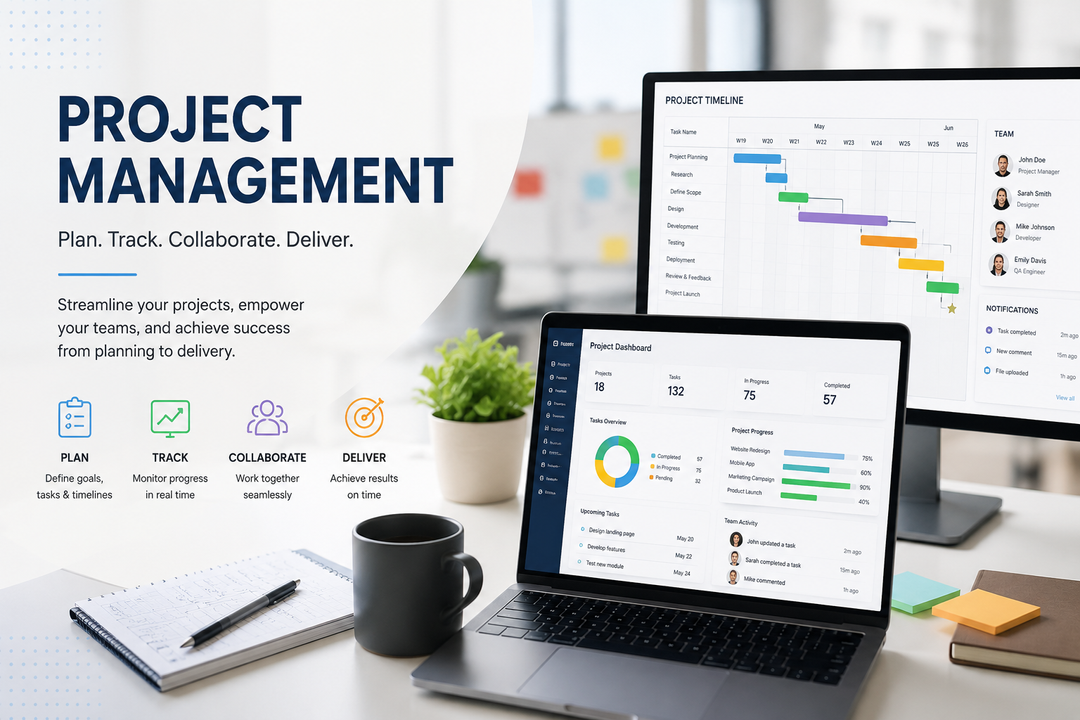
Introduction
The fast-paced environment of business requires businesses to manage multiple tasks, teams, deadlines, and other resources simultaneously. In such conditions, without proper planning, many projects can be delayed, overspent on budget, poorly communicated, and even inefficient. Project management is the solution to this problem.
Project management is a set of planning, organizing, performing, controlling, and successfully completing projects by achieving their predetermined objectives, deadlines, and budgets. If you want to release a new piece of software, start a marketing campaign, build a structure, implement some changes, and more all of these require proper management.
With the development of digital transformation and remote work, the need to plan and control the process of working on projects has been becoming especially urgent. The current article discusses the process of project management, approaches, strategies, tools, and much more.
What Is Project Management?
Project Management involves the use of various techniques, skills, and knowledge to project activities in order to satisfy project requirements. Project Management creates an organized framework that ensures organizations attain their set goals within a specific timeframe and budget.
Contrary to regular business operations, projects are temporary undertakings that have a definite start and finish time. They are designed to produce a unique product, service or outcome.
Project Management should be geared towards:
Defining project objectives
Project Scope and Time Frame Planning
Effective resource allocation
Risk management
Performance tracking
Successful project completion
As per PMI, the process of project management assists firms in bringing their visions to reality by making them efficient and minimizing risks.
Why is Project Management Important for Business?
Firms using project management techniques are benefited with greater efficiency, cooperation, and success within projects.
Some advantages are:
Efficient use of resources
Better teamwork
Increased project visibility
Decreased project risks
Quicker decision-making
Greater client satisfaction
Alignment with organizational goals
Project management promotes clarity and responsibility in ensuring everyone knows their roles and what is expected in the project.
Five Phases of Project Management
There are five important phases involved in the project management life cycle.
Initiation
Here, the project scope is determined, project objectives set, and relevant stakeholders identified.
Planning
The schedule, budget, and resources are all determined by project managers, while risks are also considered.
Execution
The team executes various project activities, undertaking all required project activities as per the project plan.
Monitoring and Controlling
This involves measuring project progress relative to the set project objectives to keep track of any deviations.
Closing
In this stage, the deliverables are completed, and the stakeholders accept the deliverables.
Such a life cycle provides structure for project management, ensuring better success rates for projects.
Important Project Management Principles All Organizations Should Adopt
Projects are often managed on the basis of certain principles which help them succeed.
Some of the key principles of project management include:
Defining project objectives
Stakeholder involvement
Effective communication
Risk management
Holding people accountable
Continuous monitoring
Making informed decisions
Such concepts are critical to maintaining consistency in projects.
Important Project Management Roles and Responsibilities
Project success is dependent on role clarity.
Project Manager
Plays a key role in planning, coordination, risk management, and project completion.
Project Team
Performs activities and brings their knowledge to the table during the life of the project.
Stakeholders
These are individuals or groups who are affected by the project.
Sponsors
Provides support for the project with funding and guidance from top-level executives.
Establishing responsibilities prevents confusion.
Required Project Management Skills for Today’s Professionals
Today’s project managers need technical as well as soft skills.
Important project management skills include:
- Leadership
- Communication
- Problem-solving
- Negotiation
- Time management
- Risk assessment
- Decision-making
- Strategic thinking
The ability to manage projects well allows professionals to guide teams in overcoming difficulties related to projects.
Common Project Management Approaches and Models
Each project requires a unique approach to be managed well.
Agile
The flexible approach which encourages iterative development and feedback.
Waterfall
An approach in which one phase needs to be completed before the other begins.
Scrum
A model under the agile approach which employs development iterations known as sprints.
Kanban
A visual workflow management system designed to improve efficiency.
Lean
It stresses minimizing waste and maximizing value.
Selecting the right project management approach is dependent on the complexity of the project, organizational structure, and business goals.
How to Develop an Effective Project Management Plan
Project management plans are the blueprint for conducting projects.
Elements of an effective project management plan include
Strives to minimize waste and increase value.
The choice of an appropriate project management methodology is dependent on several factors such as the complexity of the project, the organizational structure, and organizational goals.
How to Develop an Effective Project Management Plan
Project Management Plan is the route map for the implementation of projects.
A good project management plan includes:
- Project objectives
- Scope definition
- Timeline and milestones
- Budget estimates
- Resource allocation
- Risk assessment
- Communication strategy
- Success metrics
Planning helps minimize uncertainties and increases the probability of success for projects.
Resource Management Techniques to Ensure Project Success
Resource management is about ensuring that appropriate resources are available.
These include:
- Capacity planning
- Resource forecasting
- Workload balancing
- Skill-based assignments
- Performance monitoring
Resource efficiency enhances productivity and avoids delay in projects.
Risk Management and Mitigation Methods for Projects
Any project is filled with uncertainties, which require proper management to avoid becoming serious problems.
Risk management processes can be categorized into
Identification of risks
Analysis of risks
Prioritizing risks
Planning for mitigation of risks
Risk Monitoring
Risk management ensures that risks are reduced, which reduces disruption.
Stakeholder Management and Communication in Project Management
The involvement of stakeholders is very important for the entire project management process.
Successful communication involves:
- Defining communication channels
- Regular status updates
- Feedback collection
- Transparent reporting
- Conflict resolution
Effective communication ensures trust and cooperation between teams.
Financial Planning for Project Budgeting, Cost Control, and Resources
Finances are essential to any project management process.
The company should:
- Set a realistic budget
- Monitor costs
- Ensure good cost performance
- Manage the budget properly
- Allocate resources efficiently
A well-planned budget can help avoid financial risks in the future.
Project Management KPIs and Performance Measurement
Key Performance Indicators (KPIs) help teams evaluate project success.
Common project management KPIs include:
- Schedule performance
- Budget variance
- Task completion rate
- Resource utilization
- Customer satisfaction
- Project ROI
Measuring KPIs ensures that proper decisions can be made for future projects.
Common Problems Encountered by Project Managers and Their Solutions
Project managers face problems during their project work.
These problems are:
Scope Creep
Can be avoided using proper requirements and change management.
Missing Deadlines
Solved by realistic scheduling and effective monitoring.
Budget Overrun
Controlled through continuous cost monitoring.
Communication Gaps
Solved through cooperation and communication methods.
Resource Constraints
Managed using correct resource planning.
Having this knowledge assists organizations to develop appropriate strategies.
Best Project Management Tools for Team Collaboration and Productivity
The technology age has revolutionized project management practices.
Popular project management tools provide:
- Task management
- Project tracking
- Team collaboration
- Workflow automation
- Reporting and analytics
Organizations today use software applications to enhance visibility and efficiency in their project management processes.
Taskity and similar applications help companies combine all activities related to project management into one single environment.
Agile vs. Waterfall Project Management: Making a Smart Choice
Perhaps one of the most frequently discussed issues in organizations is whether Agile or Waterfall project management should be used.
Agile
- Flexible and iterative
- Continuous feedback
- Fast adaptability
Waterfall
- Sequential and structured
- Defined requirements
- Predictable planning
- Suitable for stable projects
Organizations should select the approach which matches their needs better.
Project Management for Different Industries: IT, Construction, Marketing, Healthcare, and Manufacturing
Project management can be applied in many industries.
IT and Software Development
Supports product development, testing, and deployment.
Construction
Guarantees that construction projects are delivered on time.
Marketing
Manages campaign development, content creation, and events.
Healthcare
Develops projects aimed at enhancing patient care and technology use.
Manufacturing
Facilitates planning and improves efficiency within manufacturing operations.
Each field is positively affected by effective planning and implementation strategies.
Certification Courses for Project Managers and Continuing Education
Professional certifications allow managers to build credibility and gain experience.
Commonly taken certifications include:
- PMP (Project Management Professional)
- CAPM (Certified Associate in Project Management)
- PRINCE2
- Agile Certified Practitioner (PMI-ACP)
- Scrum Master Certifications
Continuous learning keeps individuals competitive in their respective fields.
The Effects of Artificial Intelligence in Project Management
Artificial Intelligence is changing how projects are managed.
AI-based capabilities include:
- Predictive analysis
- Automated scheduling
- Resource forecasting
- Risk prediction
- Intelligent reporting
Using AI-based project management systems will help organizations make better decisions.
Tips for Managing Projects Remotely and Hybridly
The trend of distributed teams is revolutionizing project management.
Tips to follow include:
- Setting communication rules
- Employing collaboration systems
- Holding virtual meetings
- Monitoring project status
- Promoting team involvement
Remote project management must ensure that there is balance between flexibility and accountability.
Future Trends in Project Management
Several factors will influence the future of project management.
They are:
- Project planning using AI
- Workflow automation
- Hybrid workplaces
- Data-based decisions
- Collaboration technology
Companies embracing the above mentioned trends will stand a better chance of success in the future.
Improvements to Project Management and Collaboration by Using Troop Messenger
Efficient communication is one of the critical factors for effective project management.
Troop Messenger contributes to enhancing collaboration in teams by means of:
- Instant messaging
- Team communication channels
- File sharing
- Discussions
- Collaboration across functional lines
As a result, better communication enables improved project coordination and less information hoarding.
Conclusion
Project management is not only about task and deadline management; it is a strategy-oriented activity aimed at efficient execution of the project and achieving high productivity.
Through the use of reliable project management methods, taking advantage of advanced collaboration tools, communication strategies, and new technologies like artificial intelligence, project results can be greatly improved.
Regardless of whether you are managing software development, marketing activities, construction, or corporate transformation projects, project management skills will continue to form the basis of business success.
FAQs
What is project management?
Project management involves the planning, organizing, implementation, control, and completion of projects through achieving certain objectives, time, and budget constraints.
What are the five phases of project management?
The five phases consist of initiation, planning, implementation, monitoring and control, and termination.
Which project management methodology is best?
It all depends on project needs. The most effective methodology will be agile if the project is highly dynamic, while waterfall if the project is well-defined and static.
Why is project management important?
Project management increases efficiency, minimizes risks, encourages collaboration, and promotes project success.
What skills are required for successful project management?
Some of the top skills required for effective project management include leadership skills, problem-solving abilities, decision-making skills, communication skills, time management, and risk management.
How does AI improve project management?
Artificial intelligence plays an integral role in enhancing project management processes.