

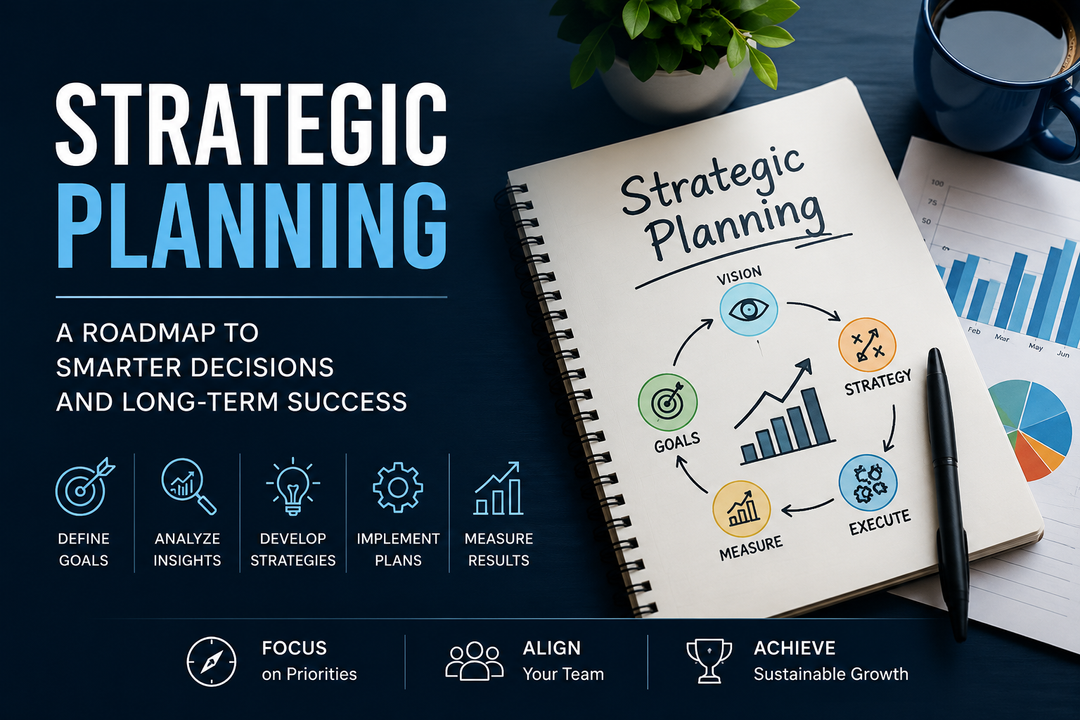
Strategic planning is the foundation upon which every success story of any firm is built. This involves a structured approach in the achievement of long-term goals through prioritization of activities and resources allocation amidst a tough business environment. While the regular running of business ensures efficient operations, strategic planning ensures that the business runs in the right direction.
Given the dynamic nature of technology and consumer needs and unpredictable markets, businesses cannot afford to act reactively anymore .They require a framework through which they ensure that everything within the business is moving in one direction to achieve the vision of the firm. It helps businesses unlock potential, manage risks, perform better, and maintain an advantage despite the dynamic market environment.
Strategic planning involves setting strategic goals, evaluating KPIs, and essentially everything involved with the implementation of a strategy. This book gives a detailed discussion of strategic planning , models used, practical applications, and recommended best practices that organizations undertake for successful implementation.
What Is Strategic Planning?
Strategic Planning Simply it's all about achieving the company's goal on a long term basis & also planning to execute in what way. It gives us all a direction of our destination and how to reach it .Unlike other organizational plans that emphasize operational issues, strategic planning enables organizations to set their goals for the future and develop appropriate measures to meet them.
Strategic plans usually answer four fundamental questions, which include the following:
Where are we now?
Where would we like to be?
How will we get there?
How will we know when we have succeeded?
Why Strategic Planning Is Essential for Long-Term Business Success
Organizations exist in dynamic environments that pose significant threats to their success. An organization that lacks a strategic plan tends to suffer from misaligned objectives, ineffective resource utilization, and poor decision-making.
The strategic planning process offers many advantages:
It offers clarity for an organization
Promotes alignment of employees toward shared objectives
Improves resource allocation
Improves decision-making ability
Enables better risk management
Promotes innovation and development
Favors competitive positioning
By setting up objectives and targets, organizations can more effectively respond to changes and maintain focus on the objectives.
Core Elements of an Effective Strategic Plan
All effective strategic plans consist of various components.
Vision Statement
The vision states the state of affairs that the organization wishes to realize.
Mission Statement
The mission outlines the reason why an organization exists and its responsibilities.
Strategic Objectives
These refer to objectives that can be quantified by an organization in pursuit of its vision.
Strategic Goals
Strategic goals act as specific targets in guiding decision making.
Key Performance Indicators (KPIs)
These tools can be used in assessing organizational performance.
Action Plans
Action plans detail the actions required for implementation of a strategy.
Through this process, all these factors contribute toward crafting a business strategy.
The Strategic Planning Process: From Vision to Execution
Strategic planning is not an event but a process involving assessment, planning, execution, and review.
Step 1: Assessment of the Present Environment
The organization conducts the assessment of the environment both internally and externally.
Step 2: Development of Vision and Objectives
The organization creates vision and objectives that can be used for many years to come.
Step 3: Creation of Strategic Initiatives
The initiatives and projects are developed based on the objectives.
Step 4: Determination of Budget Needs
The organization determines its budget needs, labor needs, and IT needs.
Step 5: Implementation of the Plan
Initiatives are implemented and aligned with the strategy.
Step 6: Monitoring and Improving Performance
Monitoring performance and improving performance is a key step.
Strategic Planning Frameworks for Making Better Decisions
They help achieve greater efficiency in decision-making processes.
Strategic Planning Frameworks for Making Better Decisions
They help achieve greater efficiency in decision-making processes.
SWOT Analysis
SWOT aids organizations in recognizing strengths, weaknesses, opportunities, and threats.
Balanced Scorecard
The Balanced Scorecard methodology gauges performance of organizations from financial, customer, business process, and learning viewpoints.
OKRs (Objectives and Key Results)
OKRs link organizational goals with results.
PESTLE Analysis
Pestle analysis is a method which focuses on analyzing political, economic, social, technological, legal, and environmental factors.
Porter's Five Forces
It provides companies an opportunity to measure the level of their competitive advantage within the market environment.
Selection of this framework should be determined by corporate objectives and industry conditions.
How Strategic Planning Creates a Competitive Advantage
Strategic planning allows companies to recognize opportunities before their competitors do.
Those that use proper strategic plans will be able to:
- React quickly to any changes
- Enhance customer experience
- Operate efficiently
- Generate innovative ideas
- Enhance brand image
Instead of responding to problems, strategic organizations prepare for them and solve any issues before they become a problem.
Strategic Planning ,Tactical Planning , Operational Planning
These types of plans complement each other, but their uses vary.
Strategic Planning
Deals with long-term strategy and aims of an organization.
Tactical Planning
Is about the practical application of strategy within departments.
Operational Planning
Considers daily tasks and short-term planning.
Strategic planning establishes the end point; tactical planning, the route to get there; and operational planning, the everyday drive along the way.
The Role of Strategic Planning in Modern Management
Modern leaders must balance immediate operational demands with long-term organizational growth.
- Strategic planning supports management by:
- Enhancing decision-making
- Improving organizational alignment
- Supporting change management
- Increasing accountability
- Driving continuous improvement
Leaders who embrace strategic planning create stronger, more resilient organizations capable of navigating uncertainty.
Strategic Workforce Planning for Future-Ready Organizations
Your employees are essential to achieving strategic objectives. Strategic workforce planning can help your company obtain the talent, expertise, and capacity needed to continue to develop and grow into the future.
Primary workforce planning activities involve:
- Talent forecasting
- Skills gap analysis
- Succession planning
- Employee development programs
- Workforce optimization
Organizations that align workforce strategies with business objectives are better positioned for long-term success.
Strategic Financial Planning for Sustainable Growth
Financial planning ensures strategic initiatives receive the resources required for execution.
Strategic financial planning involves:
- Budget development
- Revenue forecasting
- Capital allocation
- Cost management
- Risk assessment
Organizations can ensure the best gains from their investment by using financial assets to serve their strategic focus areas.
Applying Strategic Planning Across Business Functions
Strategic thinking isn’t something reserved for senior management alone; it affects all departments.
Marketing
Helps with customer development and branding.
Sales
Ensures revenue goals align with business goals.
Human Resources
Formulates employee strategies that align with organizational strategy.
Operations
Increases efficiency and resource effectiveness.
Information Technology
Facilitates technology investments to match strategic focus areas.
Common Strategic Planning Challenges and How to Overcome Them
Most companies face difficulties in planning and implementation.
These difficulties include:
- Inconsistency among company leaders
- Poor communication
- Shortage of resources
- Resistance to change
- Absence of clear objectives
Incomplete performance monitoring
Overcoming these difficulties can be achieved through accountability, good communication, and constant review.
Best Practices for Building a Successful Strategic Planning Strategy
Successful organizations apply effective planning processes.
Set Measurable Goals
Goals must be measurable, realistic, and in line with organizational objectives.
Involve All Important Stakeholders
Involving leaders and workers promotes greater consistency.
Prioritize Making Informed Decisions
Good data leads to better strategies.
Keep a Flexible Approach
Strategies need to be responsive to the market environment.
Regularly Evaluate Strategic Processes
This allows organizations to remain on target.
Applying these practices greatly enhances the odds of success.
Real-World Strategic Planning Examples and Use Cases
Companies from different sectors utilize strategic planning for their growth and innovation.
Technology Companies
Invest in Research and Development.
Healthcare Organizations
Enhance patient care while maintaining efficiency in operations.
Financial Institutions
Enhance risk management and compliance with regulations.
Manufacturing Companies
Streamline operations through supply chain optimization and increased productivity.
All the above examples highlight the importance of strategic planning in companies.
Measuring the Success of Strategic Planning Initiatives
Measurement is essential for understanding whether strategic initiatives deliver desired outcomes.
Important metrics include:
- Revenue growth
- Profitability
- Customer satisfaction
- Employee engagement
- Market share
- Operational efficiency
- Project completion rates
Regular KPI tracking enables organizations to identify strengths, address weaknesses, and make informed decisions.
Strategic Planning Tools and Technologies Every Business Should Know
Technology plays a crucial role in modern strategic planning.
Popular tools include:
- Project management software
- Business intelligence platforms
- Performance management systems
- Collaboration tools
- Data analytics solutions
- Workforce planning software
These technologies improve visibility, accountability, and strategic execution across the organization.
Emerging Trends Shaping the Future of Strategic Planning
Strategic planning continues to evolve alongside technological advancements and changing business expectations.
Key trends include:
- Artificial intelligence-driven decision-making
- Predictive analytics
- Remote workforce planning
- Digital transformation initiatives
- Real-time performance monitoring
- Scenario planning and forecasting
Organizations that embrace these trends can improve agility and maintain a competitive advantage.
Conclusion
Strategic planning is more than a business exercise—it is the foundation for sustainable growth, informed decision-making, and long-term success. In an increasingly competitive and rapidly changing business environment, organizations that invest in a clear strategic planning process are better equipped to identify opportunities, manage risks, and align resources with their goals.
With time as businesses continue to grow, those that choose to implement strategic planning as a continuing process and not an activity will fare better in their efforts to attain success. This applies whether you are a new firm looking to grow or an old company looking to improve its performance. In either case, a good strategic plan can work wonders for you.
FAQs
Define Strategic Planning
It is the process whereby organizations formulate their long-term objectives and devise action plans that will ensure achievement of these objectives.
Tell us more on how it is important to have a strategic planning in an organization?
The organizations get direction and make decisions properly, teams gets align to each other, business sustains in market over a period of time.
Tell us about the key stages of a strategic planning?
Phases of strategic planning: assessment, planning of goals, strategy formation, planning of resources, business execution and strategic planning evaluation.
Differentiate between strategy planning and operation planning?
It refers to strategic thinking on the objective with long term view, whilst operation planning focuses on short-term objectives.
What strategy planning model suits you best?
There is no perfect strategy planning model. Common models used include SWOT, Balanced Scorecard, OKR and PESTLE analysis.
How often should the strategic plan be assessed and evaluated?
Organizations need to assess and evaluate their strategic plans every quarter while comprehensive evaluation occurs once a year.
What is the role of KPI in the strategy plan?
KPIs helps in monitoring of progress, evaluation of performance, and identification of goal, as well.
Discuss the contribution of strategic workforce planning towards business growth
Strategic workforce planning ensures the organization possesses the capabilities necessary to realize future goals.