

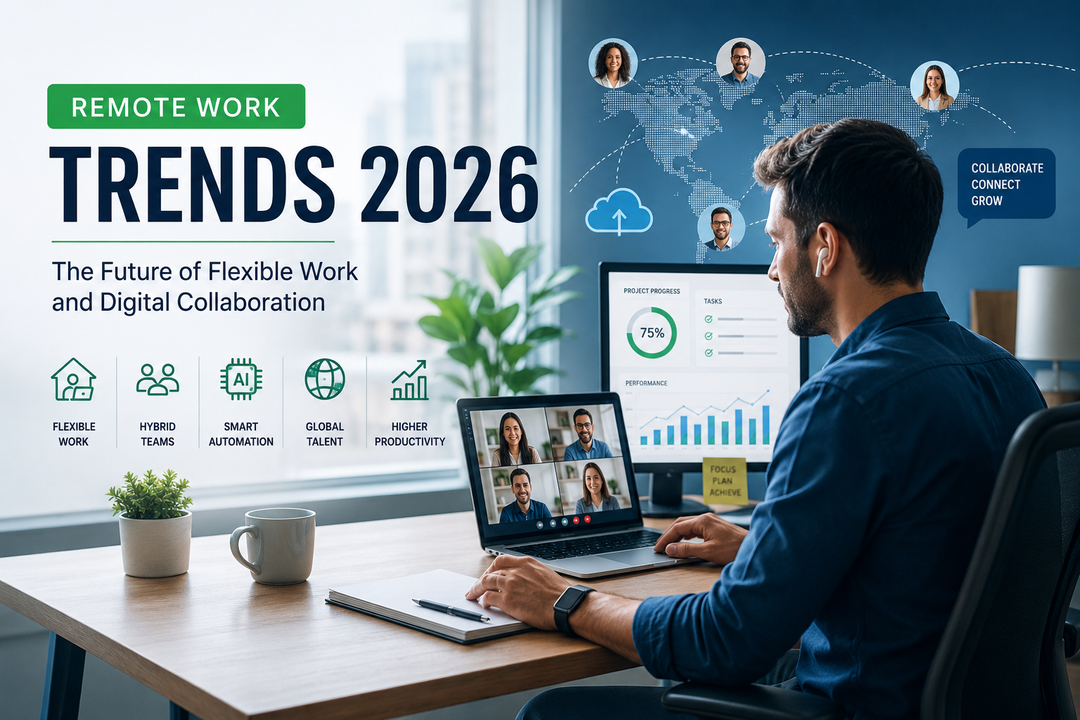
There have been tremendous changes observed in the workplace within the recent years. The phenomenon of remote working is not considered an emergency anymore; rather, it became a strategy for attracting talented employees, achieving greater flexibility, and increasing productivity. Thus, learning about the remote working trends 2026 is a necessary condition for successful businesses.
Organizations all over the world invest into various digital solutions, artificial intelligence, analytics concerning the workforce, and the improvement of employee experiences. Flexibility is a necessity among employees while employers try to find out new ways to keep their productivity, engagement, and security at a high level within the remote environment.
In 2026, remote work will be characterized by innovations, technology adoption, and data-based decision making. Organizations that will implement these tendencies will be able to attract more talent and be more efficient in their work.
Why Remote Working Trends 2026 Matter for Businesses
The concept of remote work has gone far beyond being a perk at work and is now an integral part of the modern business strategy. The question has moved from if companies should allow remote work to how they can make remote work as effective as possible.
According to remote working trends 2026, businesses need to combine the principles of flexibility, productivity, collaboration, and employee satisfaction. Businesses capable of implementing such remote work trends will get a competitive advantage.
However, businesses unable to embrace the innovations associated with remote work will face difficulties in recruiting skilled personnel due to changed workforce expectations.
AI-Powered Workflows Are Reshaping Remote Teams
AI technology is one of the most powerful drivers of remote work transformation. Thanks to AI solutions, employees have an opportunity to automate routine tasks, boost communication, and make informed decisions in a more efficient way than ever.
Businesses tend to use AI for:
- Automation of administrative workflows
- Generating meeting notes
- Project planning
- Analysis of team productivity
- Communication
Thanks to automation of routine tasks, employees get a chance to concentrate on more important aspects of their work.
How Automation Is Reducing Administrative Work
Many remote employees spend valuable time on routine tasks such as scheduling meetings, organizing files, creating reports, and tracking project updates.
Automation technologies are helping organizations eliminate these inefficiencies by handling repetitive activities automatically. This allows teams to spend more time on meaningful work while improving overall productivity.
As AI capabilities continue to advance, automation will become a standard component of remote workplace operations.
Hybrid Work Models Continue to Dominate Modern Workplaces
One of the most important remote working trends 2026 is the continued growth of hybrid work environments. Rather than choosing between fully remote and fully in-office models, organizations are adopting flexible arrangements that combine both approaches.
Hybrid work offers several advantages:
- Greater employee flexibility
- Improved work-life balance
- Enhanced collaboration opportunities
- Reduced office costs
- Increased talent accessibility
Many organizations are discovering that hybrid work provides the optimal balance between productivity and employee engagement.
Balancing Flexibility and Collaboration
Although flexibility is extremely important, companies need to make sure that their employees have strong ties within their teams.
To overcome the above problem, organizations are using:
- Collaboration days
- Virtual team building programs
- Technology for communication
- Project management procedures
The best hybrid work environment will be one that allows employees to work independently and collaborate.
Global Hiring Is Expanding Beyond Traditional Talent Pools
Distance work has eliminated the constraints of geography, opening up new possibilities for recruitment. Now firms can recruit experts from almost any part of the globe.
With distance hiring, firms get access to:
- Technical skills
- Various views
- Inexpensive talent
- Greater workforce flexibility
Global hiring gives firms the opportunity to create better teams despite any shortages of talent in the industry.
Those firms that adopt global hiring strategies will have many more advantages in a global economy.
Employee Well-Being Is Becoming a Business Priority
Employee well-being has come out as one of the most prominent trends in remote working for 2026. Companies are realizing that employee productivity and happiness go hand-in-hand.
Remote workers may experience problems like:
- Isolation
- Burnout
- Communication fatigue
- Lack of work-life balance
In order to overcome such problems, companies have been putting effort into providing wellness programs, flexible hours, mental health facilities, and a healthy workplace culture.
Preventing Burnout in Remote Work Environments
Burnout continues to be one of the greatest threats linked to prolonged remote work.
Organizations are employing measures like:
- Flexi working hours
- Periods without meetings
- Health activities
- Management training
- Employee feedback meetings
This will ensure that the employees sustain good working habits as well as productive ones.
Data-Driven Productivity Tracking Is Replacing Micromanagement
Management used to use direct supervision and time-based performance measurement techniques. But that is not what remote work calls for.
One of the most influential remote work trends for 2026 is outcome-based performance measurement.
Companies are interested in measuring:
- Rates of project completion
- Goal achievement
- Team collaboration
- Customer satisfaction results
- Productivity performance measurement
It means that an organization can measure its performance using results and not the number of hours put in.
Modern project management software allows tracking team performance and supporting team members without micromanagement.
Cybersecurity Investments Are Increasing Across Remote Organizations
Cybersecurity has become an important business consideration because of the increased trend of remote working. Remote workers will be accessing business systems from different places and on different devices, making cybersecurity more challenging.
Businesses are improving their cybersecurity through:
- Multi-factor authentication
- Cloud-based secure infrastructure
- Endpoint protection tools
- Cybersecurity training for employees
- Data encryption techniques
It is very important to keep data safe to maintain the trust of customers.
Protecting Distributed Teams from Security Threats
The employees working remotely may be potential victims of phishing scams and malware attacks.
Some measures taken by businesses include:
- Introduction of security awareness training programs
- Risk assessments
- Development of remote work security policies
- Network monitoring
These steps assist in decreasing risks and protecting sensitive business information.
Asynchronous Communication Is Becoming the Preferred Collaboration Style
In line with globalization and the expansion of teams in distant parts of the globe, there is an emerging trend of asynchronous communication.
As opposed to real-time communication, asynchronous collaboration offers workers the opportunity to work according to their convenience.
Some of the advantages include:
- Lesser meeting fatigue
- More focus time
- Proper documentation
- Flexibility
- Improved collaboration
The use of various tools for project management, shared spaces, and update documentation is increasing among organizations.
Digital Workplace Platforms Are Consolidating Team Operations
There has been an increase in the use of applications at work by companies. But using different unconnected applications leads to inefficiencies and lack of effective communication.
This is one of the new trends in remote work in 2026, whereby there is use of digital workplace applications that will integrate all operations.
Organizations are looking for a way of integrating the following in one application:
- Project management
- Team communication
- Task management
- Automation of workflow
- Performance reports
Why Unified Work Management Is Essential
When information is scattered across different systems, employees waste their valuable time in searching for any update.
Unified work management systems allow companies to:
- Boost their productivity
- Increase transparency
- Decrease complexity
- Collaborate remotely
It is projected that this trend will be gaining more popularity among companies.
Sustainability Is Influencing Remote Work Decisions
Sustainability is increasingly becoming a major factor in the implementation of remote working policies by organizations.
Remote work helps in sustainability through:
- Reducing daily commute emissions
- Reducing office energy usage
- Reducing need for business travel
Organizations are increasingly making sure that sustainability remains one of the factors in their workplace policy while utilizing remote work.
This balance between business efficiency and environmental sustainability is expected to continue well into 2026 and beyond.
What Businesses Should Expect Beyond Remote Working Trends 2026
Work in the future will keep on changing depending on the changes in technology, worker demands, and the needs of businesses.
The organizations will have to expect:
- Increasing use of AI
- Advancements in workforce analytics
- Increased international cooperation
- Greater flexibility at the workplace
- More emphasis on worker experience
Companies that embrace the future changes will be able to face the coming days more comfortably.
The companies that will win will be those which see remote work not only as a workplace policy but as an advantage.
How Taskity Helps Teams Adapt to Remote Working Trends 2026
With the growing complexity of remote work settings, companies require solutions that facilitate collaboration, productivity, and accountability.
Taskity is a platform that can assist your company with the following:
- Project management
- Task tracking
- Collaboration
- Process optimization
- Workplace transparency
With its help, your company will be able to respond to the emerging remote work trends of 2026.
Conclusion
Future remote working trends 2026 focus on how flexibility, technology, and the employee experience can be combined to achieve better performance in the workplace. Artificial intelligence-based workflow processes, hybrid work environment, global recruitment practices, cybersecurity, and digital workplace technologies have revolutionized the way businesses function.
Companies that adopt these remote working trends will have an edge over others in terms of productivity, employee engagement, and resilience of the organization. With the right approach and technological tools, companies will be able to succeed in this ever-evolving world of work.
FAQs
Which industries are likely to benefit most from remote working trends in 2026?
The sectors such as technology, marketing, consulting, finance, customer support, and education among others will be positively impacted by remote work since they will take advantage of digital collaboration.
How does remote work influence talent acquisition?
Remote work enables firms to hire employees from other areas which makes it easier to get access to more specialized skills and to increase chances in competitive sectors.
Will remote work completely substitute office workplaces?
It is unlikely that remote work will completely substitute office workplaces and many companies are predicted to opt for hybrid models of operation.
What technologies will facilitate remote working trends in 2026?
Technologies such as artificial intelligence, cloud computing, workforce analytics, project management systems, collaboration technologies, and cybersecurity solutions will be key enablers of remote working.
How can firms prepare for remote working trends in 2026?
Firms should be prepared to invest in digital workplace solutions, enhance cybersecurity measures, promote well-being among other factors.